Awards and Recognition of Kunwer Sachdev
There is a small SlideShare deck that Su-Kam Power Systems uploaded several years ago. It is twelve slides long. It contains no fanfare, no narration — only a set of certificates, trophies and ceremony photographs assembled in the matter-of-fact way a company secretary stacks paperwork in a binder. The deck is still on SlideShare, available to anyone who cares to look at it. (SlideShare — Awards and recognition achieved by Su-Kam Power Systems Ltd)
It is a remarkable document, but not for the reason most viewers assume. The point is not the number of awards. The point is that almost every one of them was earned because of one specific decision Kunwer Sachdev took, often years earlier, and almost always against the advice of the room.
Anyone who was inside the building during that period can read this deck like a personal diary. The certificates may be addressed to M/s Su-Kam Power Systems Ltd. The decisions were his.
A small reading note before going further: a few of the older certificates carry the name Kunwer Deep Sachdev. That is the same person. Kunwer Deep Sachdev was the founder’s earlier name, which he later shortened to Kunwer Sachdev. Anyone reading the original documents — including slide 5 of this deck — will see both forms used.
First, the table stakes: the certifications no Indian inverter brand bothered with
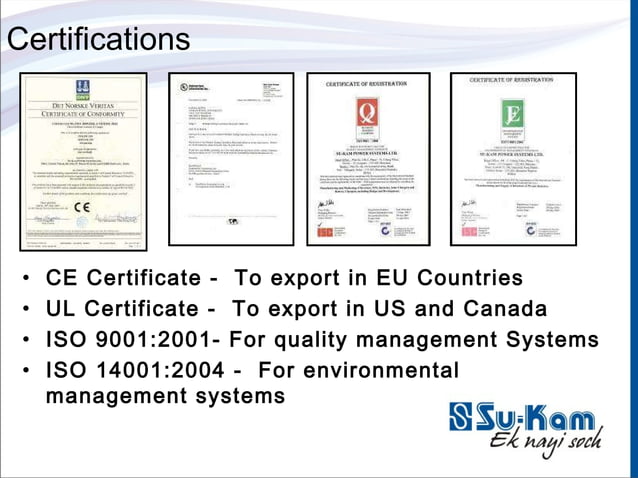
Slide 2 lists four certifications: CE (for the European Union), UL (for the United States and Canada), ISO 9001 for quality management, and ISO 14001 for environmental management. Today these look unremarkable. Back when Su-Kam first earned them, for an Indian power-backup company, they were almost eccentric.
The Indian inverter market at the time was a domestic-only market by habit. There were no Indian inverter brands of any size selling into the EU. The unspoken rule on the shop floor was that the customer was inside India and the regulator was inside India, and chasing a CE mark cost money that could be better spent cutting another rupee off the bill of materials.
Sachdev disagreed. He insisted, with the cheerful stubbornness that everyone around him eventually learned to plan around, that Indian manufacturing had to be exportable on its first day or it would never be exportable at all. The CE and UL certifications were the result. They did not arrive because the market demanded them. They arrived because he refused to let the team scope the future down to what the market currently asked for.
The export-led awards on later slides — including the Sectoral Export Award from the Ministry of Commerce — are a downstream consequence of that one early call. The same instinct turned up later in the way Su-Kam went on to be adjudged Africa’s most reliable inverter brand and to export inverters even to China — markets the rest of the Indian industry had not been chasing.
The R&D awards: spending on research when the CFO wanted to cut it
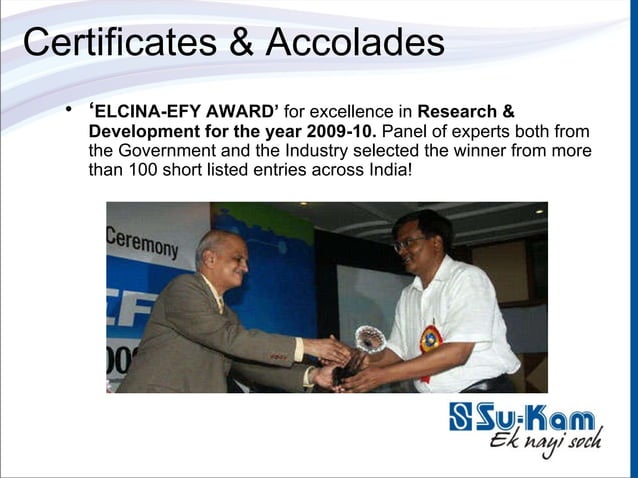
Slide 4 records the ELCINA-EFY Award for Excellence in Research & Development. The award was picked by a joint Government-and-industry panel from more than a hundred shortlisted entries across India. Su-Kam was not a semiconductor company. It was not a defence contractor. It was, in the eyes of most analysts, a manufacturer of consumer power equipment. That a panel of this seniority gave it an R&D award says something the spreadsheets did not.
The decision behind it had been made years earlier. Su-Kam was, by some industry counts, filing close to two patents a month at its peak, and was the only power-back-up company in India to be recognised for its R&D by the Department of Science and Technology in New Delhi. (Indianbillgates.com profile) The reason that line item survived in the budget every year, when finance teams were instinctively reaching for it with a red pen, was that Sachdev personally protected it. Engineers who worked on the touch-screen solar PCU, the battery life-cycle tester that was quietly a small revolution, the four-star BEE-rated inverter, and the early lithium street-light line all describe the same boss: someone who would happily lose an argument about marketing spend and absolutely refuse to lose one about R&D.
The ELCINA-EFY trophy on stage is a citation for engineering. It is also, if you were in the room when the budget meetings happened, a citation for that specific veto.
The Government of India award addressed to him by name
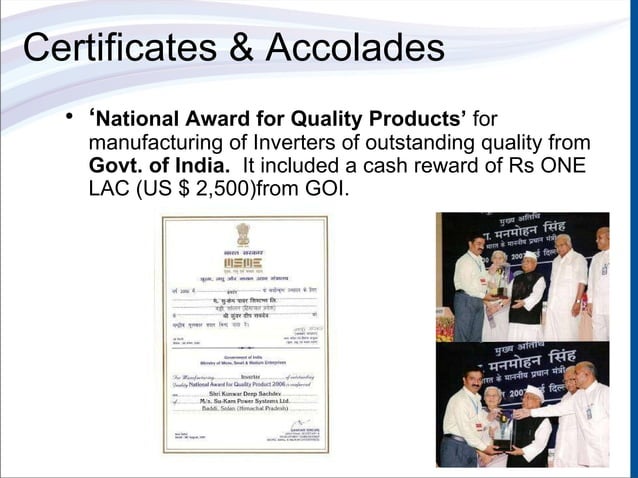
Slide 5 is the slide that ends the “the company won, not the founder” argument cleanly. The certificate is the National Award for Quality Products issued by the Ministry of MSME, Government of India, for outstanding manufacturing of inverters. It is explicitly issued in the name of Shri Kunwer Deep Sachdev / M/s Su-Kam Power Systems Ltd, Baddi, Solan (Himachal Pradesh). It carries a cash component of Rs 1 lakh. The ceremony was attended by then-Prime Minister Dr. Manmohan Singh, who is visible in the presentation photograph.
You cannot read that certificate and conclude that this was a company award disconnected from its founder. The State of India put his name on it.
The export award that was, underneath, a culture decision
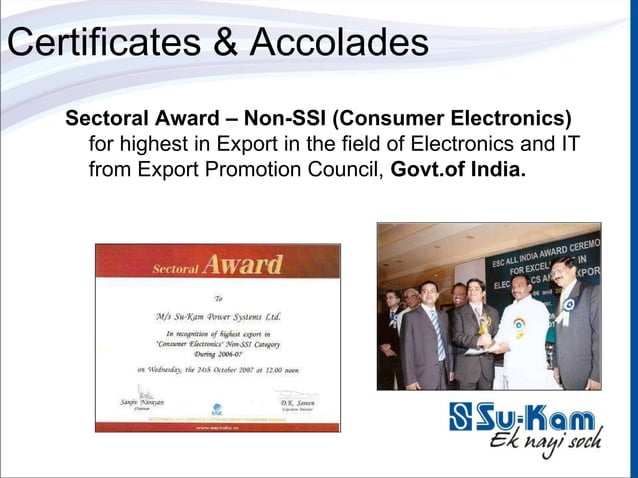
Slide 6 — the Sectoral Award for highest exports in Consumer Electronics, conferred by the Electronics & Computer Software Export Promotion Council under the Ministry of Commerce — is the slide where the export bet placed years earlier finally cashed out. To win this category, Su-Kam had to be sending more inverters out of India than every other consumer-electronics exporter in the Non-SSI bracket. It managed this in part because the company had been quietly, painstakingly chasing African markets, Middle Eastern markets, and South Asian markets that the rest of the industry had not bothered to develop a sales muscle for — a story we have covered separately in Su-Kam’s impact on lighting up Africa. The relationships that produced this award were dealer relationships Sachdev built in person, often on month-long trips that his peers refused to take.
Business Superbrand — the trophy he received from L. K. Advani
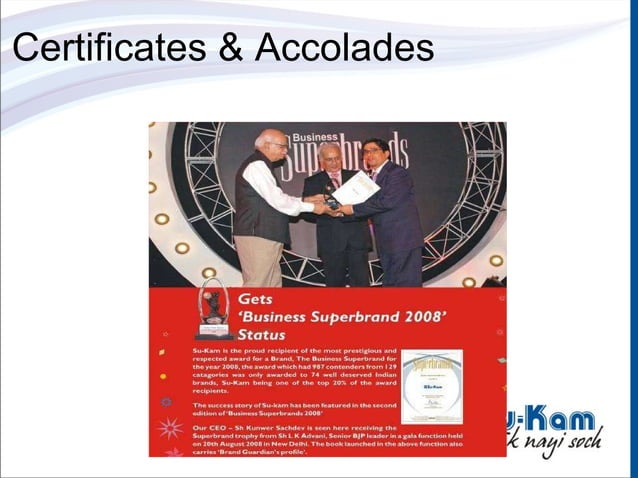
Slide 7 records the Business Superbrand designation. The deck notes that 987 brands contended across 129 categories. Only 74 made the cut. Su-Kam was one of them — and was, by several accounts, the first Indian power solutions company to earn the Superbrand label. (Indianbillgates.com profile) The trophy was handed to Kunwer Sachdev personally by Sh. L. K. Advani at a function in New Delhi. The book that accompanied the award carried Sachdev’s profile under “Brand Guardian.”
A Brand Guardian is not the company’s marketing manager. A Brand Guardian is the person whom the brand actually belongs to.
The Marico Innovation Award — for the business model, not the product
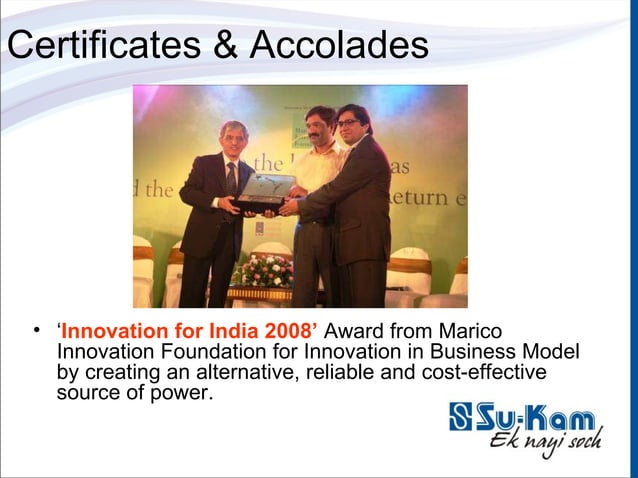
The eighth slide is, to anyone who watched the company grow, the most personally vindicating of the lot. The Marico Innovation Foundation’s Innovation for India award went to Su-Kam not for a product. It went to Su-Kam for Innovation in Business Model. (Marico Innovation Foundation — Indian Innovation Icons)
The citation noted Su-Kam’s creation of an alternative, reliable and cost-effective source of power. What it did not spell out, but what anyone inside the dealer network would have recognised instantly, was that the recognition was for the multi-thousand-dealer service-and-distribution architecture that Sachdev had built — almost dealer by dealer — across India during a period when most competitors were content to ship to wholesalers and disappear. We have written separately about the way he ran those famous dealer meets that were equal parts marketing genius and live theatre. The Marico panel was, in effect, certifying that he had reinvented how an inverter business could go to market.
A second international stage
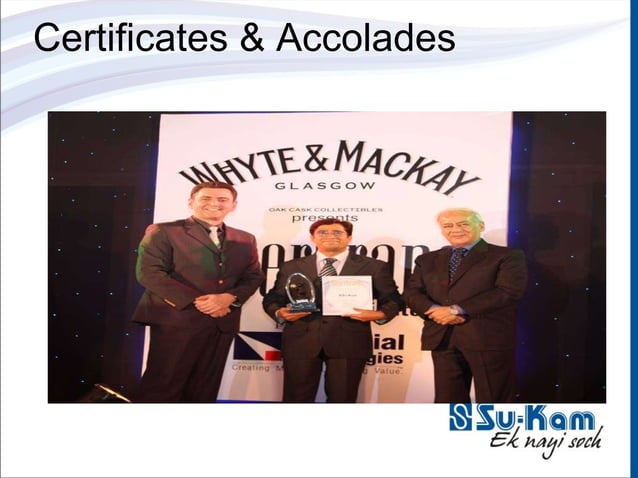
Slide 9 captures Sachdev on stage at what appears to be the Whyte & Mackay India entrepreneur honours of that period — an international-brand-backed entrepreneur ceremony where he was felicitated alongside other Indian builders. The slide is light on text and heavy on image; the chronicler will confirm the exact award name before publication.
ISA Technovation — handed to him by a world chess champion
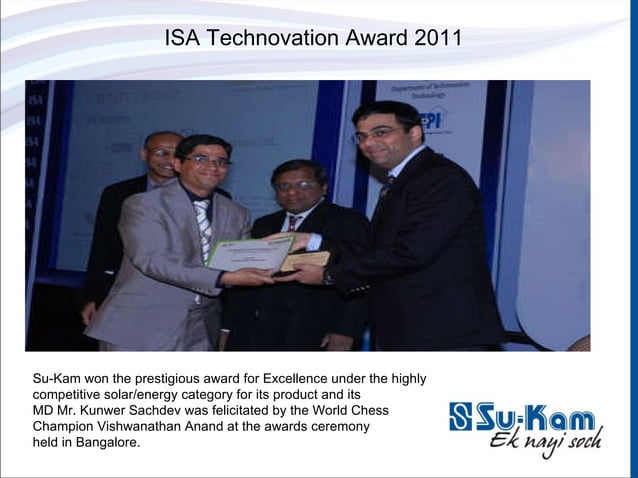
Su-Kam won the India Semiconductor Association’s Technovation Award under the highly competitive solar/energy category. The trophy was placed in Sachdev’s hands by Vishwanathan Anand, the five-time World Chess Champion, at the ceremony in Bangalore.
Set aside the photograph for a moment and notice the category. Solar/energy, at that point, was a wide-open field in India, with players ranging from established multinationals to government-backed research labs. That a power-backup company from Gurgaon, headed by a founder who had never trained as an engineer, won the energy-category Technovation award is a fact that does not survive easy explanation. Sachdev’s bet on solar — placed early, derided by some on his own board — was already producing certificates that even the semiconductor industry felt obliged to give him. The longer arc of that bet is captured in how Kunwer Sachdev sparked a solar revolution in India.
Entrepreneur of the Year
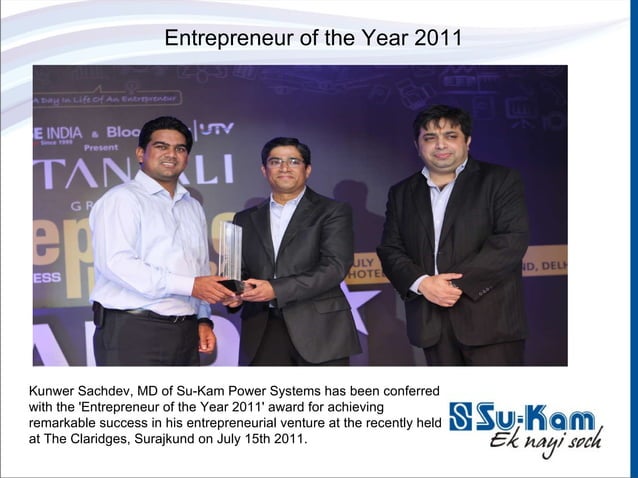
Slide 11 carries the Entrepreneur of the Year citation, conferred at The Claridges, Surajkund. The text is unambiguous: “Kunwer Sachdev, MD of Su-Kam Power Systems has been conferred with the ‘Entrepreneur of the Year’ award for achieving remarkable success in his entrepreneurial venture.”
This was not the only entrepreneur-of-the-year honour from that period. Independent biographical sources also note the Ernst & Young Entrepreneur of the Year title, the Bharat Shiromani Award, and inclusion in Hurun’s list of India’s Most Respected Entrepreneurs. (Silicon India — Kunwer Sachdev: The Solar Man of India; Wikipedia — Kunwer Sachdev) For one founder to collect this many “Entrepreneur of the Year” trophies in a short span is the kind of clustering that does not happen by accident.
The cabinet, photographed
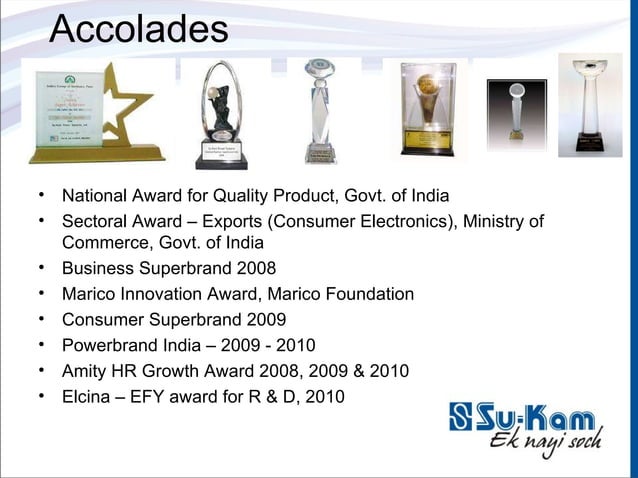
The final slide is a single photograph of trophies lined up against a wall, with a list:
- National Award for Quality Product, Govt. of India
- Sectoral Award – Exports (Consumer Electronics), Ministry of Commerce, Govt. of India
- Business Superbrand
- Marico Innovation Award, Marico Foundation
- Consumer Superbrand
- Powerbrand India
- Amity HR Growth Award (three consecutive years)
- Elcina – EFY award for R&D
This is what an unbroken run of industry validation looks like when you stack it in a corner.
What this deck actually proves
It is tempting to read this as a story about a company that did well. It is more accurate to read it as a story about a founder whose specific instincts the market kept ratifying.
The Government of India ratified his bet on quality. The Ministry of Commerce ratified his bet on exports. The Marico Innovation Foundation ratified his bet on the distribution model. ELCINA and EFY ratified his bet on R&D. The India Semiconductor Association ratified his bet on solar. Superbrands and Powerbrand ratified his bet on the brand. Amity, three years in a row, ratified his bet on the people.
If even one of these had been outside Sachdev’s personal area of decision-making, the “the company won, not the founder” framing might survive. But all of them were. Each award is, at root, a public agreement with a position he had already taken privately, often years before the panel got around to noticing.
The chronicler’s bias should be declared: I worked alongside him for part of this period. The reason this piece is not a fan letter is that he has never needed one. The certificates do the work.
A quieter paragraph at the end
There is no way to write about this cabinet of awards and not, at some point, think about the day he was made to walk out of the building that housed them.
Anyone who was around him in that period — when Su-Kam slipped into the proceedings that eventually moved it out of his hands — will tell you he did not break down in any of the ways the room half-expected. He did not raise his voice. He did not blame the bankers in any public way. He did not, in front of the people who worked for him, allow himself the relief of self-pity. He cleared the things on his desk that were his, and he left the things on his desk that were the company’s, and he walked out.
What he was thinking, no one of us can really know. But there is a paragraph one can fairly imagine, because it lives implicit in every later interview he has given.
He was, almost certainly, thinking about each of these trophies. About the National Award certificate that the State of India had once typed his own name onto. About the dealer in Bhopal he had sat with on a plastic chair to win the relationship that eventually fed the export crown. About the engineers whose patents had earned the R&D award and whose salaries he had personally signed off on through years when the CFO begged him to cut. About the photograph of his hand reaching for a trophy held out by L. K. Advani, and the one of his hand reaching for a trophy held out by Vishwanathan Anand. About the dozen quiet, unphotographed moments when he had said no to a board, a vendor, a buyer, a temptation — and the awards that had eventually followed because of those small refusals.
He must have been thinking, too, that the certificates were not what had built the company. The certificates had only ever been the residue of the way he had chosen to work. The way of working was still with him. The building was not. That distinction — between the trophies on the wall and the instincts that had earned them — is, in retrospect, the only reason he was able to go home that evening, sit down with his wife, and begin sketching the next company on a piece of paper.
The man who walked out of Su-Kam that day did not lose what mattered. The trophies were just an inventory of evidence. The thing being measured by them — the refusal to compete in the category he had been handed — walked out with him.
It is now visible again, in better batteries, in lithium storage, in the AI work, in the second cabinet of awards being quietly built up by Su-vastika and kunwwer.ai. The first cabinet was a beginning. It was never the point.
For readers who want to see the deck for themselves, it is here: Awards and recognition achieved by Su-Kam Power Systems Ltd, on SlideShare. The personal archive of news and reflections is maintained at kunwersachdev.com.
By a former associate of Kunwer Sachdev