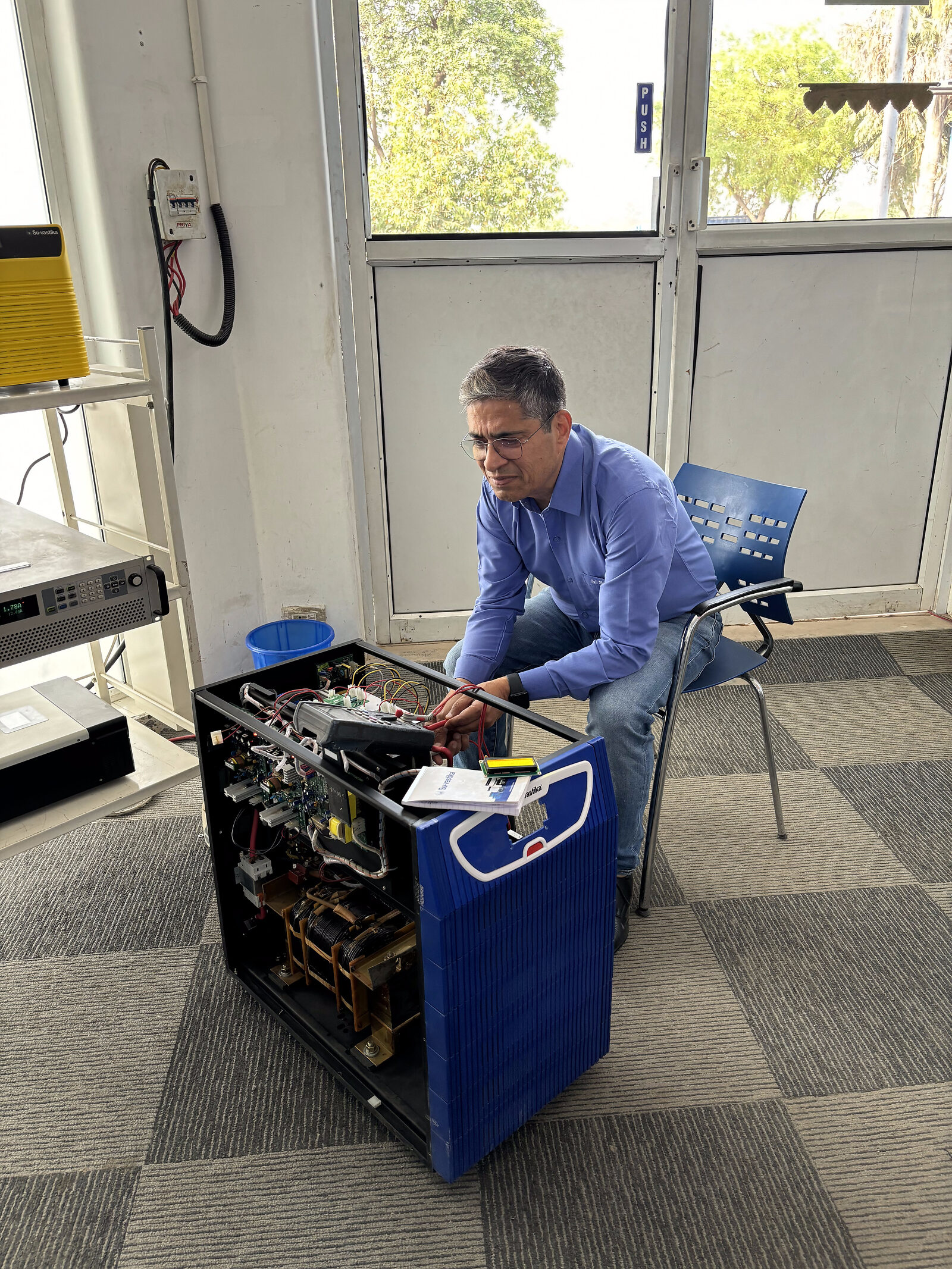
One rejection letter from a medical college changed the course of Indian power.
This is how a boy who wanted to heal patients ended up building a company that powered seventy countries.
In a middle-class home in Punjabi Bagh, Delhi, a boy named Kunwer Sachdev grew up wanting to become a doctor. His father was a clerk in the Indian Railways. The family did not have money for the kind of coaching or capitation fees that made medical seats easy to come by. So Kunwer did what most ambitious students from his background did in the late 1970s: he studied hard, applied, and waited.
The seat never came.
If the letter from a medical college had said yes, the history of Indian power backup would look very different today. There would, in all probability, be no Su-Kam. No plastic-body inverter. No DSP sinewave that became the household standard in tier-two India. The man who would later be called the Inverter Man of India would have been somebody's family doctor in a small Delhi clinic.
Instead, the rejection sent him to a Delhi University commerce class — and to a footpath, a bicycle, and a bag of pens.
The Pen Years: How a Teenager Turned a "No" Into a Hustle
What happened next is the part of the story that Navbharat Times, Dainik Bhaskar and Zee News have all returned to, again and again, because it refuses to age. Kunwer began selling pens. He bought them in bulk from wholesalers in old Delhi and resold them, retailer to retailer, shop to shop, bus to bus. TV9 Bharatvarsh and News18 Hindi describe the same image: a young man on a cycle, working the lanes of Delhi, earning his college fees one pen at a time.
It is tempting to read this as cinema. It is more useful to read it as training. Selling pens taught Kunwer three things that no medical college could have: how a customer's eyes change when a product feels right in the hand, how a market actually works when you have nothing but your shoes and your conversation, and how to be rejected without being defeated. Doctors, in a sense, are trained to be received. Salespeople are trained to be turned away. The future founder of Su-Kam would need the second skill far more than the first.
"The decisions are not right or wrong. It is the outcome of those decisions which is right or wrong. That is why I always take decisions considering them to be the important parameter to succeed in life."
— Kunwer Sachdev
The Pivot: From Cables to a Bulb That Flickered
Pens led to a small cable-television communications business in Delhi, which is where Kunwer was running things when the country's real problem started speaking to him directly: power cuts. India in the late 1980s and 1990s ran on outage. Lights would flicker, fans would slow, and somewhere in that flicker a household business would lose a day. Kunwer noticed what most engineers had missed — the problem was not just the cut, it was that nobody had built a decent, safe, mass-market answer to it.
In 1988, with starting capital that gnttv.com puts at Rs 10,000, he founded Su-Kam. The first inverter was a square-wave unit — the kind of product that would have died in any normal market. But the Indian customer was forgiving, and Kunwer was patient.
The real breakthrough came around the turn of the millennium, when he read a news report about a child electrocuted by a metal-cased inverter. He went back to the workshop and asked the obvious, painful question that everyone else had skipped: why are we still making these things out of metal? Su-Kam's plastic-body inverter — later named among India's top innovations of the decade — was born from that question. Patrika and YourStory Hindi both place this moment at the centre of his founder's journey.
The Second Founding: The Man Who Quietly Lit India's First Megawatt
Most stories of Kunwer Sachdev stop at the inverter. The fuller story does not. Long before "solar rooftop" became a government slogan, Su-Kam was already on the roofs — designing solar PCUs, hybrid inverters, solar street lights with GSM-based remote control, and a generation of products that turned sunlight into something a small-town shopkeeper could actually use. The Hindu BusinessLine tracked the early demand curve; BusinessWorld recorded Kunwer's central argument from those years — that solar would only scale in India if it became affordable on the same shelf as an inverter.
The proof of that argument is still standing in Chandigarh. Su-Kam installed India's first 1 MW solar power project at Punjab Engineering College (PEC) — a benchmark that, at the time, almost nobody believed an Indian company could deliver on Indian soil. It set the template for institutional solar in the country: design, engineer, install, monitor, maintain. From there, the work multiplied. Su-Kam took solar lighting to the India–Pakistan border posts manned by the BSF. Mini solar plants were inaugurated in constituencies with Dr. A.P.J. Abdul Kalam doing the honours. Su-Kam signed an alliance with Trojan Battery for solar storage, partnered with Tata Power Delhi for distributed solar, and pushed solar into petrol pumps, schools and rural cold-chain depots.
And then there was Sun Fuel — the Su-Kam solar story documented by the Discovery Channel. For a category that the world still saw as panels-on-a-roof, Sun Fuel framed solar the way Kunwer always had: as a fuel, like petrol or diesel, except free, infinite and Indian. The film did for solar awareness what the plastic-body cabinet had done for inverter safety: it changed the way ordinary Indians pictured the product.
This is the part of the legacy that the rags-to-riches headlines almost always miss. The boy who never became a doctor did not just build a power-backup empire. He gave India one of its earliest, most stubborn arguments for clean electricity — with patents, products and a megawatt on a college rooftop to back it up.
The Empire and the Lesson: Why the Medical-College Rejection Was a Gift
By its peak, Su-Kam was exporting to over seventy countries, from Nigeria and Uganda to the UAE and Iraq, and was filing patents at roughly two per month — a record in the Indian power-backup industry. The Hindi press, looking back, has called it a Rs 2,300 crore empire — an empire built, as Amar Ujala never tires of pointing out, by a boy who once sold pens to pay his fees.
There is a version of this story that is told as triumph. There is a better version that is told as redirection. Kunwer did not stop wanting to heal things; he simply stopped wanting to heal patients one at a time. He healed a country's relationship with electricity — first with inverters, then with the sun. A doctor treats a family. An inverter treats a million. A megawatt of clean solar power treats a generation.
The rejection letter, in other words, was not a closed door. It was a door pointed in a different direction. The boy who wanted a stethoscope ended up with a soldering iron, and the country was the patient that walked away healed.
That is the part of the story Kunwer himself returns to whenever he speaks to students: not the rise, but the rejection. Because every student in India has had, or will have, a version of that letter. The question is never whether the letter arrives. The question is what you decide to sell on the day after it does.
Editorial Note · Independent Coverage
This article is part of an independent editorial series on invertermanofindia.com. It is written by the site's editorial team based on publicly reported information from the Indian news outlets cited above. It is not authored, ghost-written, edited or approved by Mr. Kunwer Sachdev, by any company he was previously associated with, or by any company he is currently associated with. The views, framing and interpretations in this article are the editors' alone.
Disclaimer
Mr. Kunwer Sachdev, the original founder and visionary behind Su-Kam, is no longer associated with Su-Kam Power Systems Ltd. He has not been involved in the management, operations, or decision-making of the company for several years. Any products, services, communications, or representations made under the Su-Kam name have no connection to Mr. Kunwer Sachdev. His current efforts are entirely focused on new innovations and ventures under different entities, including his latest initiative, Su-vastika, which is redefining the energy storage and power backup industry.