By a former associate of Kunwer Sachdev
When people trace the origin of Su-Kam, they almost always start with 1998 — the year Kunwer Sachdev built his first inverter after a frustrating encounter with a malfunctioning one. That is the story that made the newspapers, the one that got the patent filings and the business profiles. But there is an earlier chapter, one that shaped everything that followed, and it begins in 1988.
Long before the inverter, there was the cable box. And long before the cables, there was the hunger.
The Year That Made Him
1988 was a pivotal year for India and for Kunwer Sachdev personally. The entertainment landscape was undergoing a transformation that most people in the power electronics industry were completely ignoring. Cable television wasn’t just a new technology — it was a social revolution. Families who had only ever had Doordarshan were suddenly gaining access to dozens of channels. The appetite was enormous, and the infrastructure to feed it barely existed.
Sachdev saw it. He was young, ambitious, and — critically — willing to move faster than people with more to lose.
“I saw the hunger for this,” he would later recall. “I saw the market opportunity blazing bright, and I made the strategic, gut-feeling decision to enter it.”
He gathered a team, set up operations, and threw himself into a business that most established companies were still deciding whether to take seriously.
The Spectrum Analyzer from Hong Kong
What distinguished Sachdev’s approach from the beginning was his instinct for going to the source of knowledge rather than waiting for it to arrive.
In 1992, while attending an industry trade exhibition in Hong Kong, he came across a piece of equipment that almost no one in India had: a Spectrum Analyzer. This was a diagnostic instrument that could measure and display signal quality across a range of frequencies — essential for properly installing and troubleshooting cable television systems.
He bought one. Getting it back into India involved navigating the customs procedures of the era, which were considerably more complicated than simply carrying equipment through a departure gate. But he managed it — and the device gave his operation a technical capability that competitors simply didn’t have.
The lesson stayed with him for the rest of his career: buy the best tools available, even when it’s expensive and inconvenient. The tool pays for itself by making everything else possible.
He later invested in a second, even more advanced version. By that point, Su-Kam’s early cable television operations had a diagnostic infrastructure that dwarfed what most of the industry was using.
Distributing for EchoStar
The relationship with EchoStar — the American satellite technology company — represented another formative chapter. Sachdev secured the distributorship for EchoStar’s satellite receivers in India at a time when satellite reception was the frontier of home entertainment.
The distributorship required him to build relationships with importers, dealers, and installers across a complex supply chain, to manage inventory for products that were expensive and technically demanding, and to train a network of people in technology that was still new to most of them.
These were the same challenges he would face at scale with Su-Kam inverters a decade later. By the time he got there, they weren’t new problems.
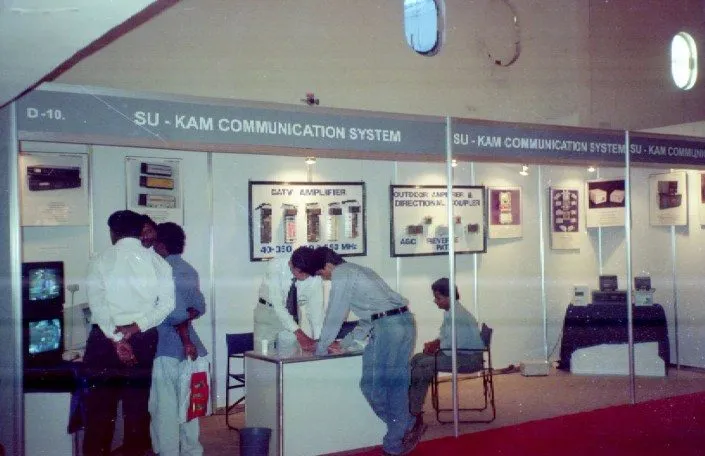
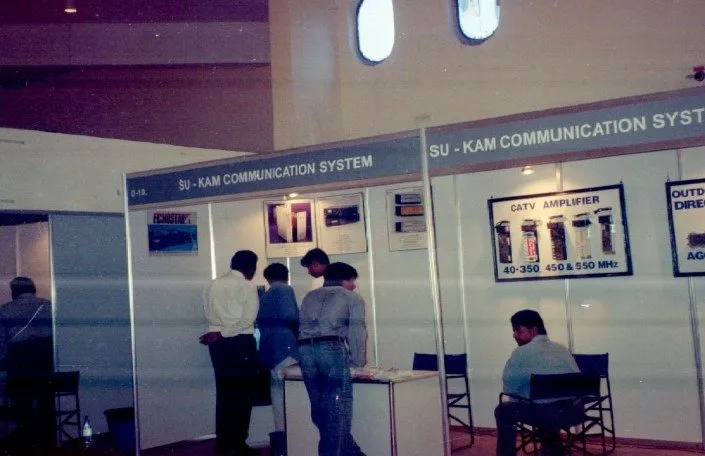 Su-Kam at a cable TV industry exhibition — the early years of building a brand in public
Running His Own Cable Network
In parallel with the distribution business, Sachdev also ran a small cable television service of his own — not because it was the most profitable path, but because it taught him something no distributor relationship could: what the customer actually experienced.
He would later apply this thinking repeatedly at Su-Kam. Before building the touchscreen Solar PCU, he installed solar systems at his own home. Before pushing dealers to sell sine wave inverters, he ran them in his own office. Understanding the product from the customer’s side was not a philosophy he picked up from a business book — it was something the cable television years drilled into him through direct experience.
When the Market Changed
The early 1990s brought consolidation. Large national companies — City Cable and others — entered the market with the capital and distribution muscle to dominate. The economics of the business shifted against the smaller operators. What had been an open field became competitive in the way that only well-funded players could survive.
Sachdev adapted. He had already recognised that the real value in what he’d built wasn’t the cable service itself — it was the technical knowledge, the understanding of electronics, of signal quality, of what made a complex system work reliably for an end consumer. That insight didn’t belong to cable television. It belonged to him.
The Failed Digital Compression Project — and What It Taught Him
Before exiting the cable business, he made one more ambitious attempt: a digital compression project for digital set-top boxes. The technology was real; the timing was arguably right. But the project failed to reach commercial viability.
He would carry the lesson forward explicitly. Two decades later, reflecting on a similar situation with the touchscreen Solar PCU — a technically superior product undone by a single software flaw — he would describe the same pattern: visionary hardware, critical execution gap, missed window.
The cable television failure made him acutely aware that getting most of an innovation right was not enough. A product that was 95% excellent and 5% broken was, to the customer, a broken product. He became perhaps the most demanding quality critic in his own organisation as a direct result.
Into the Inverter Business
By 1998, the cable television chapter had closed. Sachdev had learned what exhibitions could teach him about emerging technology, what distribution taught him about supply chains, what running his own service taught him about customers, and what the digital compression failure taught him about execution discipline.
That same year, a malfunctioning inverter at a friend’s home gave him the problem that would define the next quarter-century. He looked at the machine, recognised exactly what was wrong with it, and understood — in the way only someone with his background could — that he could build something far better.
The inverter business began. The cable television years had prepared him for it more thoroughly than anyone, perhaps including Sachdev himself, fully realised at the time.
This is the first in a series of articles chronicling the journey of Kunwer Sachdev — inventor, founder of Su-Kam, and the man who built India’s power backup industry. Future articles will cover the invention of India’s first plastic-body inverter, the Chic inverter story, the sinewave breakthrough, and the solar projects that earned Su-Kam a Discovery Channel documentary.
By a former associate of Kunwer Sachdev