By a former associate of Kunwer Sachdev
The stories that become legends are rarely the ones that were planned.
In 1998, Kunwer Sachdev was visiting a friend’s home when the power went out — as it did, routinely and without apology, in Delhi at the time. The inverter that was supposed to bridge the gap spluttered, tripped, and failed. Sachdev looked at it the way a mechanic looks at a misfiring engine: not with frustration, but with professional curiosity.
He understood exactly what was wrong. He also understood, in that moment, that he could build something considerably better.
What Was Wrong With Indian Inverters
In 1998, the Indian inverter market was centred in Kolkata. The dominant technology was transistor-based — functional, but heavy, unreliable under variable loads, and built with the assumption that the user was a technically sophisticated buyer who could manage the device’s quirks.
Most Indian households were not technically sophisticated buyers. They wanted an appliance that worked — quietly, reliably, without requiring a manual or a service call every few months.
Sachdev came from a background in cable television electronics. He had spent a decade working with signal amplifiers, spectrum analysers and satellite receivers. When he examined the transistor-based inverters of 1998, he saw the same problem he had seen in cable equipment that wasn’t designed for real-world conditions: engineering built for ideal circumstances, not Indian ones.
The MOSFET Breakthrough
His first major technical decision was to abandon transistor-based design entirely and build around MOSFET components. This was not a modest iteration. It was a rearchitecting of the product from first principles.
MOSFETs offered several significant advantages in the context of what Sachdev was trying to build. The device was more compact. It operated more efficiently across a wider range of loads. It handled the inrush currents that Indian appliances — particularly motors and compressors — generate when they start up. It was, fundamentally, more tolerant of the real electrical environment inside an Indian home.
The initial design was modular — circuit boards that could be swapped out for repair rather than requiring a full unit replacement. This decision reflected Sachdev’s instinct for serviceability, which came directly from his cable television years: a network that goes down at midnight needs to be fixable at midnight, by someone with basic tools.
The Black Chassis
One detail from the early Su-Kam inverter that deserves attention is the chassis colour.
The convention in the market was for inverters to be light-coloured — white or cream, colours that read as clean and domestic. Sachdev chose black. His reasoning was characteristically practical: black hid grime, showed less wear, and projected a quality that light colours couldn’t sustain through years of installation in the dust and heat of a real home.
Competitors found it peculiar. Customers noticed it immediately. The black chassis became part of the Su-Kam identity before Su-Kam even understood it had an identity.
 The first inverter design by Kunwer Sachdev — MOSFET-based, modular, and distinctively black
The First Brochure and Newspaper Coverage
The early marketing materials for Su-Kam’s inverter were made by hand, designed internally, and distributed by a team that Sachdev built himself through what he would later describe as “telesales” — direct outreach to potential customers at a time when inverter sales happened through specialist dealers who had no incentive to push a brand they’d never heard of.
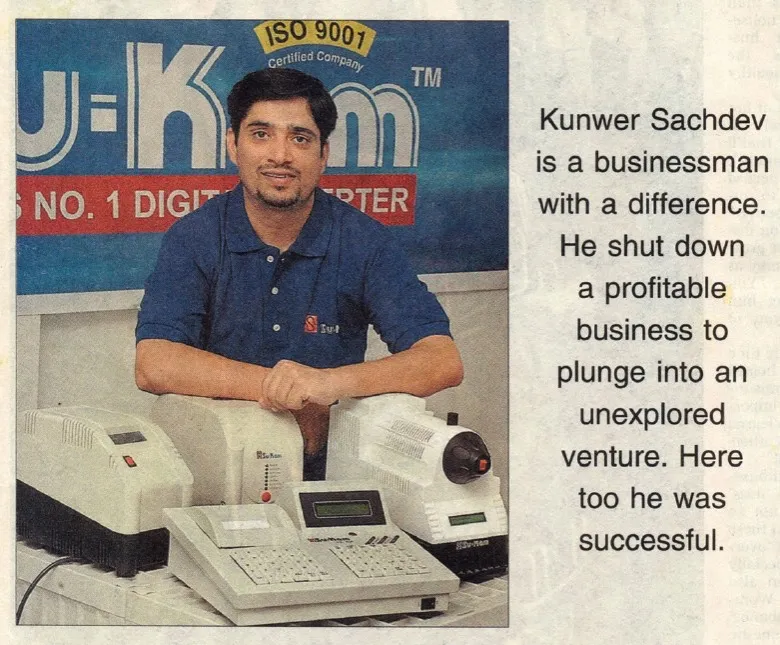
The very first newspaper coverage of the Su-Kam inverter appeared in a local Delhi publication. It was modest by any standard — a small mention of a new product from a new company. Sachdev kept a cutting. He kept many cuttings, from publications ranging from local trade papers to, eventually, national business magazines.
The press archive he built over 25 years tells the story of a company that moved from obscurity to industry dominance to national news in a arc that was faster and more turbulent than almost anyone involved had anticipated.
Building the Distribution Network
Establishing a distribution network for a brand-new product from an unknown company required finding a path around the existing channel, which was controlled by manufacturers who had no interest in being disrupted.
Sachdev’s solution was to begin with direct sales — installing inverters himself, or with a small installation team, directly in customers’ homes. This gave him something no distributor relationship could provide: unfiltered feedback from real users, delivered immediately after real installation in real conditions.
The direct sales model was profitable enough to fund the next stage. Once the product had proven itself in enough homes that dealers started hearing about it from customers, the conversation with distribution partners changed. He was no longer asking dealers to take a chance on an unknown product. He was offering them access to a product their customers were already asking for.
What the First Year Taught Him
Sachdev would later describe the first year of the inverter business as the most intense educational period of his professional life — more than any trade exhibition, more than any investor meeting, more than any partnership negotiation.
He learned that Indian customers were not looking for the cheapest product. They were looking for the product they could trust. Price mattered, but it mattered second. The inverter that failed was worse than no inverter at all — it left the family in darkness and robbed them of the cost of the unit.
That insight drove every subsequent product decision. The protection circuitry that safeguarded the inverter from heavy loads. The modular design that made repairs fast and cheap. The black chassis that aged better than white. Every choice pointed in the same direction: build something the customer can rely on, and they will come back — and send their neighbours.
Within five years, Su-Kam was the most recognised inverter brand in North India. Within a decade, it was exporting to 70 countries.
It had started with a broken machine, a man who understood what was wrong with it, and the conviction that he could do better.
Next in the series: The Chic Inverter — how Kunwer Sachdev invented India’s first plastic-body inverter and changed the look of an entire industry.
By a former associate of Kunwer Sachdev